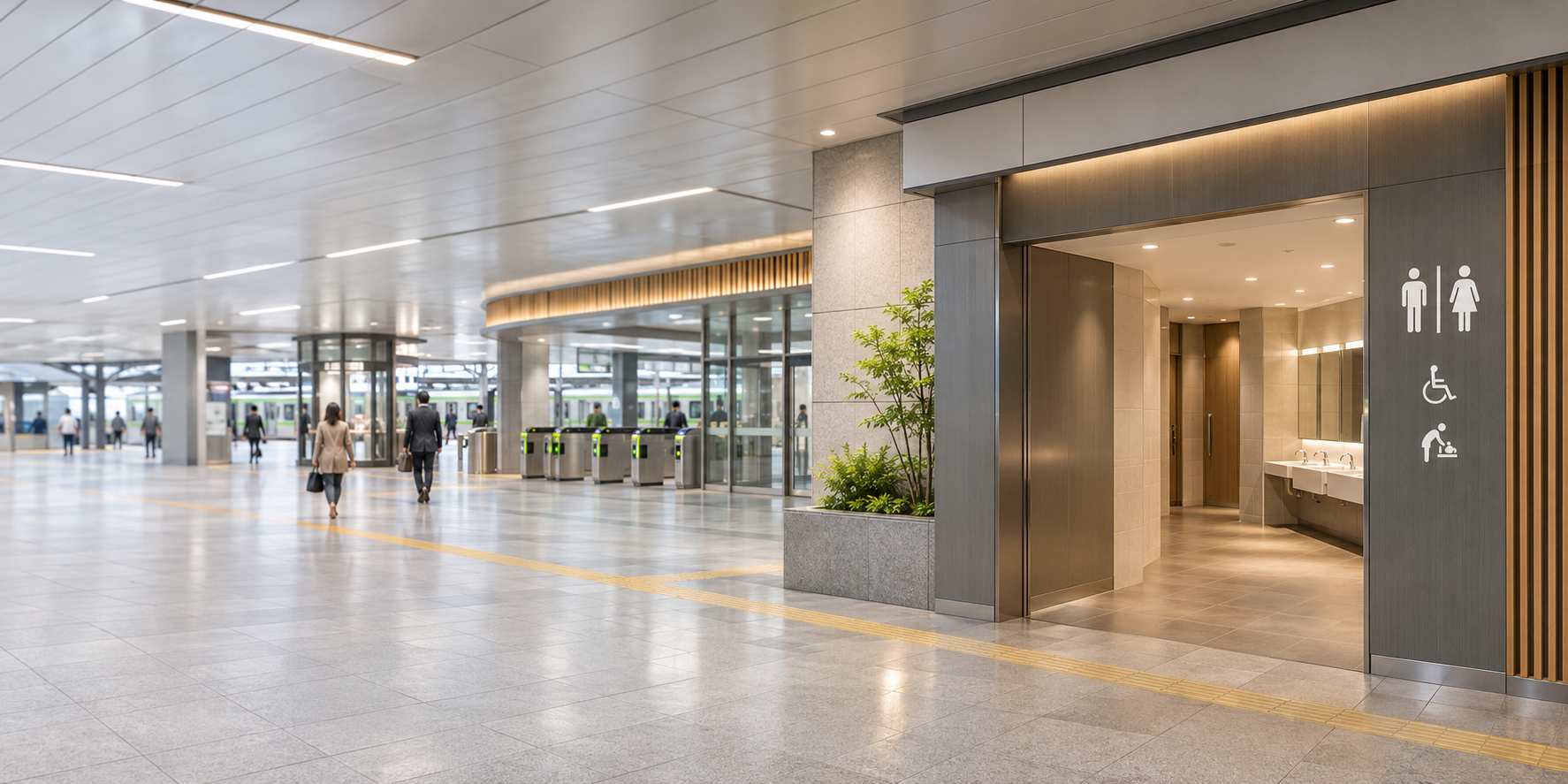
Five urinals. One water line. A defined field observation.
BeLife was installed on the wash-water supply serving an operating station restroom. The study tracked urinary-scale condition and trimethylamine, an odor-associated compound.
Odor and urinary-scale buildup in a high-use restroom.
Urinary scale can accumulate inside urinals and drain paths, contributing to visible buildup, restricted flow, cleaning burden, and persistent odor. The field study examined what happened when wash water passed through BeLife before reaching the fixtures.
Scale at every fixture
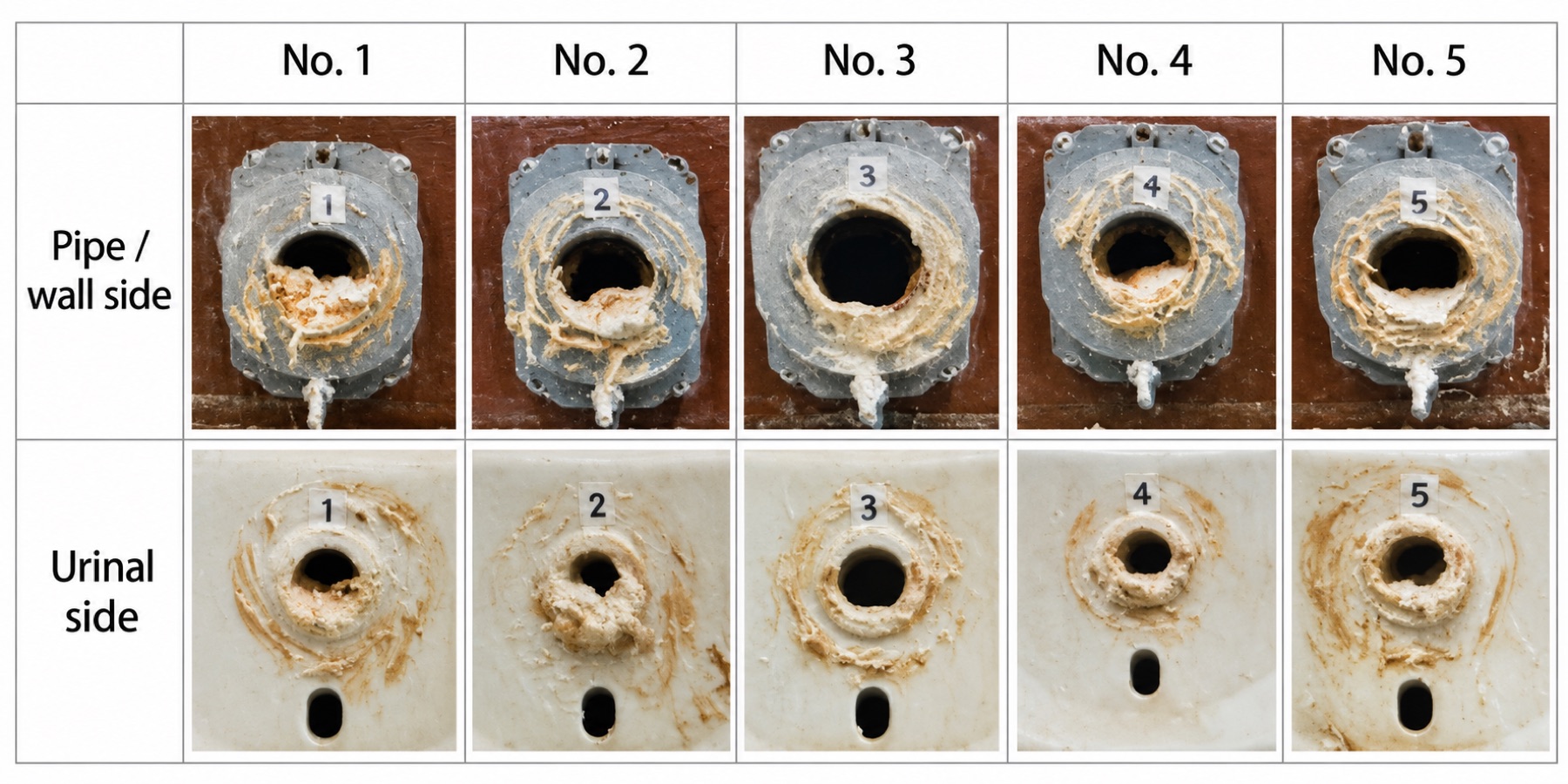
The investigators documented urinary-scale adhesion at all five urinals. No. 1 was close to obstructing the pipe, although flushing water was still passing.
Normal public use
Each urinal used a human-presence sensor with approximately 15–20 seconds of wash flow and roughly 0.18–0.26 gal (0.7–1.0 L) per cycle.
Can treated wash water change the condition?
The observation focused on scale condition, fine-bubble generation, and trimethylamine readings at each downstream fixture.
The study photographed both sides of all five connections.
Before installation, the urinals were removed so investigators could inspect the wall-side pipe connection and the urinal-side opening at each fixture.
One upstream BeLife unit served five urinals.
The device was installed at the root of the urinal wash-water supply. The five fixtures were positioned approximately 3.3, 6.6, 9.8, 13.1, and 16.4 ft (1, 2, 3, 4, and 5 m) from the installation point.
This is a field-layout reconstruction based on Fuji Keiki's published table. A qualified plumber must assess every U.S. installation independently.
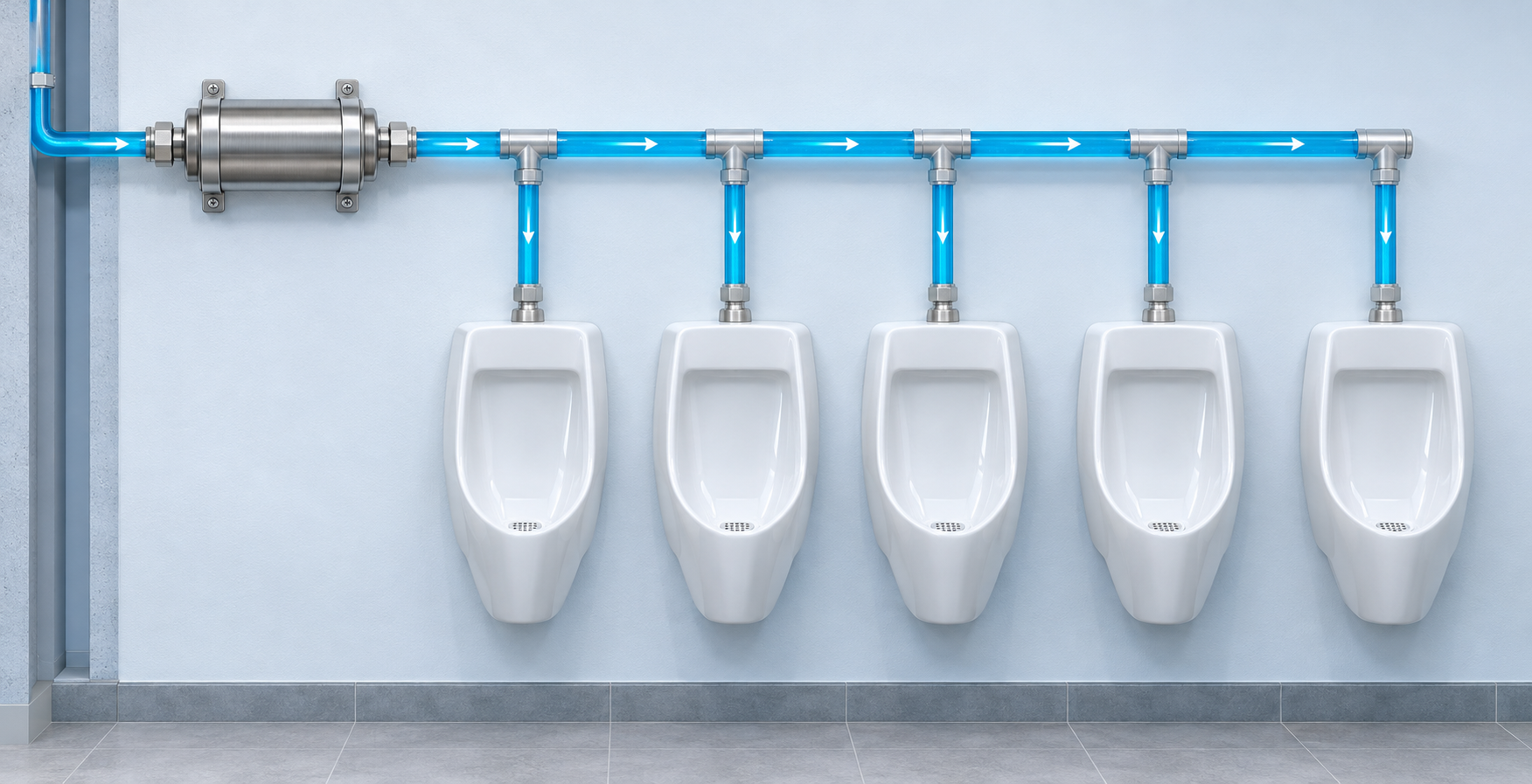
The paper identifies a NPS 1 in. (approximately 25A) supply line serving the five urinals at the selected station restroom.
The aggregate of the five post-installation sampling readings was reported at about 1.9 times the pre-installation level.
The study selected an in-line generator that produced fine bubbles without electricity.
Every measured fixture moved below the baseline range.
Before installation, the published source reports trimethylamine at more than 100 ppm—the upper measurement boundary—at all five urinals. At follow-up, the readings were 30, 7, 3, 5, and 4 ppm.
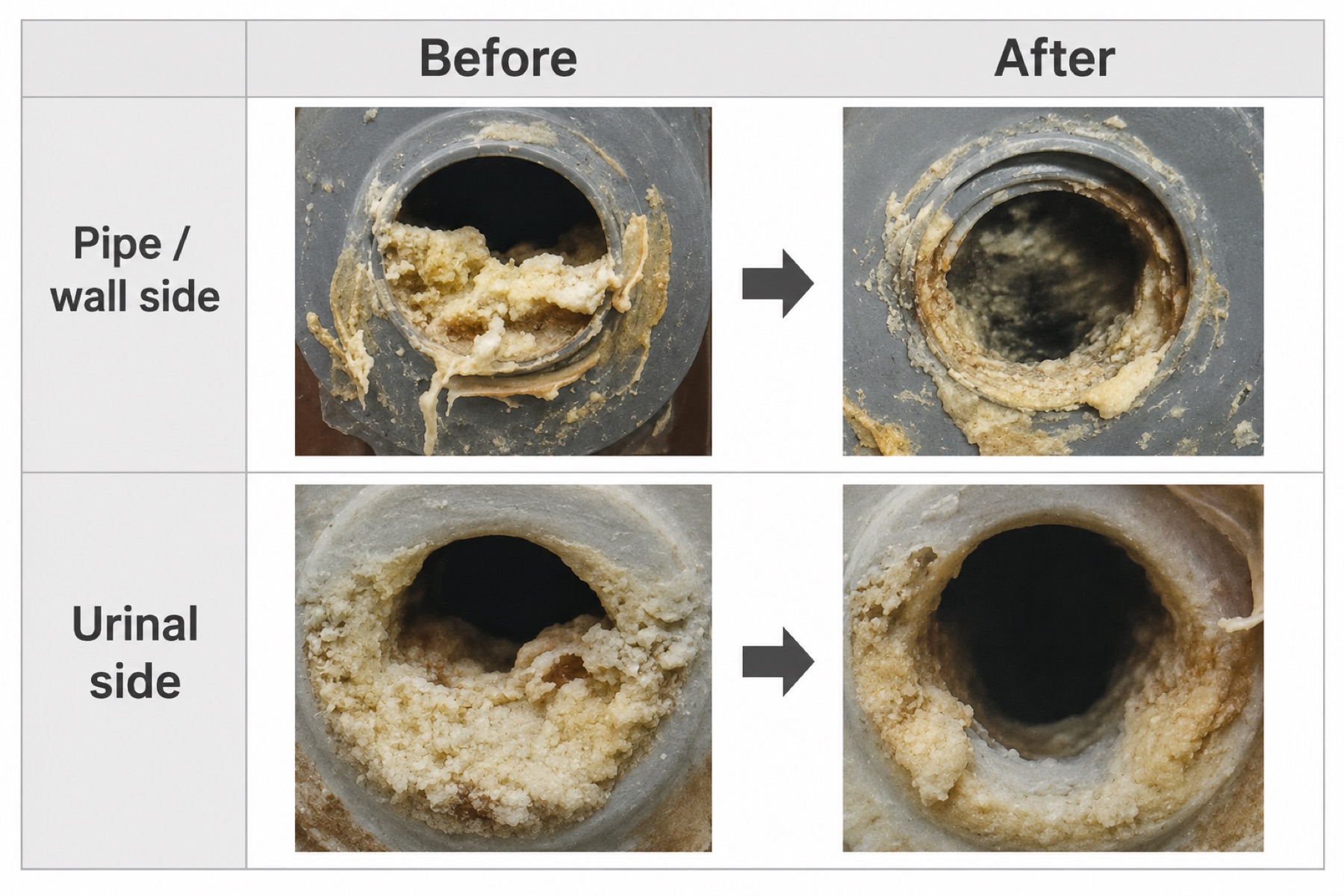
Urinary-scale condition visibly changed on both sides of the connection.
The supplied study reports that No. 1—the most obstructed fixture at baseline—showed the greatest removal. Investigators observed scale breaking away where fine-bubble-containing water passed.
More than one condition was documented—but the measures stay separate.
Trimethylamine decreased
All five fixtures were below the pre-installation measurement range at follow-up.
Urinary scale visibly changed
The paper reports scale peeling or reduction where fine-bubble-containing wash water passed, with the most obstructed fixture showing the greatest visible removal.
Other screened compounds were not detected
Ammonia, hydrogen sulfide, and methyl mercaptan were not detected in this field measurement. This case must not be presented as the separate 40.1% controlled ammonia test.
What the field case supports.
A site-specific field observation
- ✓One operating station restroom
- ✓Five urinals on one NPS 1 in. (approximately 25A) water supply
- ✓Fine-bubble sampling at five outlets
- ✓Fixture-specific trimethylamine readings
- ✓Exact before-and-after scale photographs
- ✓A defined 55-day follow-up period
A universal performance guarantee
- ✓No guaranteed result for every facility
- ✓No financial-savings calculation
- ✓No U.S. plumbing approval claim
- ✓No basis to relabel the result as ammonia
- ✓No replacement for site-specific evaluation
It connects laboratory promise to an operating environment.
The value of the JR East study is not that every restroom will reproduce the same numbers. It shows a defined installation documented fixture by fixture under normal use—with plumbing context, fine-bubble sampling, odor measurements, and physical photographs kept together.